
Language Therapy for Preschool Children

 EVALUATION &TREATMENT  A comprehensive evaluation may assess the following areas:  Expressive language (what the child says) Receptive language (what the child understands)  Play skills   In creating a treatment plan, speech-language pathologists (SLPs) work with parents, teachers and other professionals to target weaknesses found during a language assessment (formal & informal). Good language skills help with learning, […]

Language Therapy for Preschool Children Read More »
Childhood Apraxia of Speech

What is Childhood Apraxia of Speech (CAS)?  A Neurological Speech Sound Disorder where the accuracy and consistency of movements needed for speech production are impaired. It is primarily a disorder of inaccurate planned movement, known as praxis; there is a difficulty in planning and executing voluntary movement sequences.  Childhood Apraxia of Speech is NOT:  

Childhood Apraxia of Speech Read More »

Early Intervention: Therapy for Children Birth to Three

What is Early Intervention?  Early intervention is play-based language therapy provided to toddlers who are delayed in their development of speech and language.  PREDICTORS OF NEED FOR INTERVENTION Small vocabulary with limited verbs Language comprehension delay Few vocalizations, limited consonants or vowels Limited variety in babbling Restricted syllable structure Few spontaneous imitations Little or no

Early Intervention: Therapy for Children Birth to Three Read More »

Auditory Processing Disorders

Auditory Processing Disorders

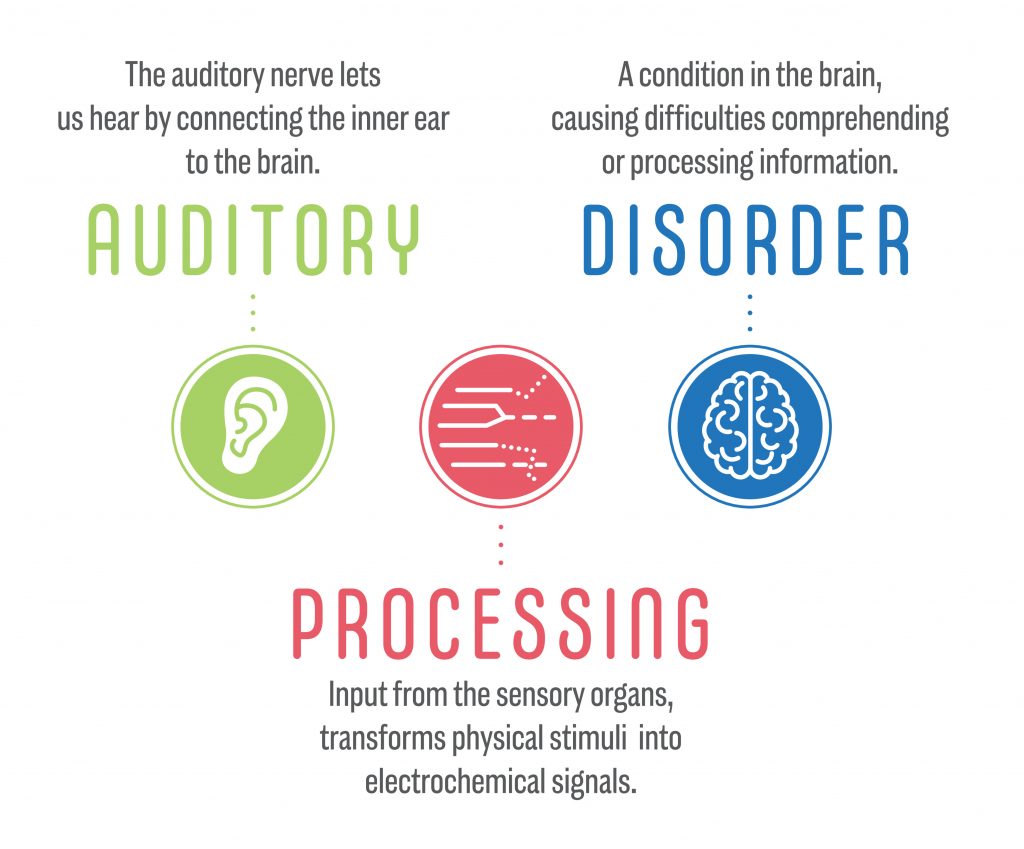
An Auditory Processing Disorder (APD) refers to a variety of conditions that affect theway the brain processes auditory information. APD is different from a hearingimpairment, in that individuals with APD generally have normal hearing ability. Rather,an individual with APD cannot process the information they hear in the same way thatothers do. This can lead to

Auditory Processing Disorders Read More »

Myofunctional Therapy

An orofacial myofunctional disorder, or tongue thrust, refers to a “reverse” swallowingpattern in which the tongue pushes against or between the teeth. The tongue rests lowand forward in the mouth, and the lips can be flaccid with an open posture. All babies thrust their tongues when they are sucking and swallowing. This is a normalpattern

Myofunctional Therapy Read More »

Making Sense of Intervention Approaches for Autism Spectrum Disorders

Parents or caregivers of children diagnosed with an autism spectrum disorder(ASD), often face the challenge of dealing simultaneously with affects of thediagnosis on the family system as well as adhering to advice to start interventionimmediately. With the overwhelming growth of information on traditional and nontraditional therapies for autism spectrum disorders (ASDs), a review of an

Making Sense of Intervention Approaches for Autism Spectrum Disorders Read More »

Articulation Therapy

WHAT IS AN ARTICULATION DISORDER?  An articulation disorder is defined as the atypical production of speech sounds. It is characterized by substitutions, omissions, additions and/or distortions that may interfere with how well someone’s speech is understood. Articulation disorders can be classified as either functional or organic. Functional disorders have no known cause, where as organic

Articulation Therapy Read More »

Working with Acquired Communication Disorders in Adults

WHAT IS A NEUROGENIC COMMUNICATION DISORDER?  Neuropathologies or brain trauma often result in language deficits. Some characteristics you may observe in your loved one may include: improper use of words and their meanings, the inability to express ideas, inappropriate grammatical patterns, reduced vocabulary, and the inability to follow directions. A person’s cognition may also be

Working with Acquired Communication Disorders in Adults Read More »